
Forgetting John Digweed
On Bedrock, abandoned limestone quarries in the south of France, the persistence of one's forgetting, a memory of one’s persistence, forgetting to write, and writing to remember

“The most important thing is the thing most easily forgotten.”
(73)
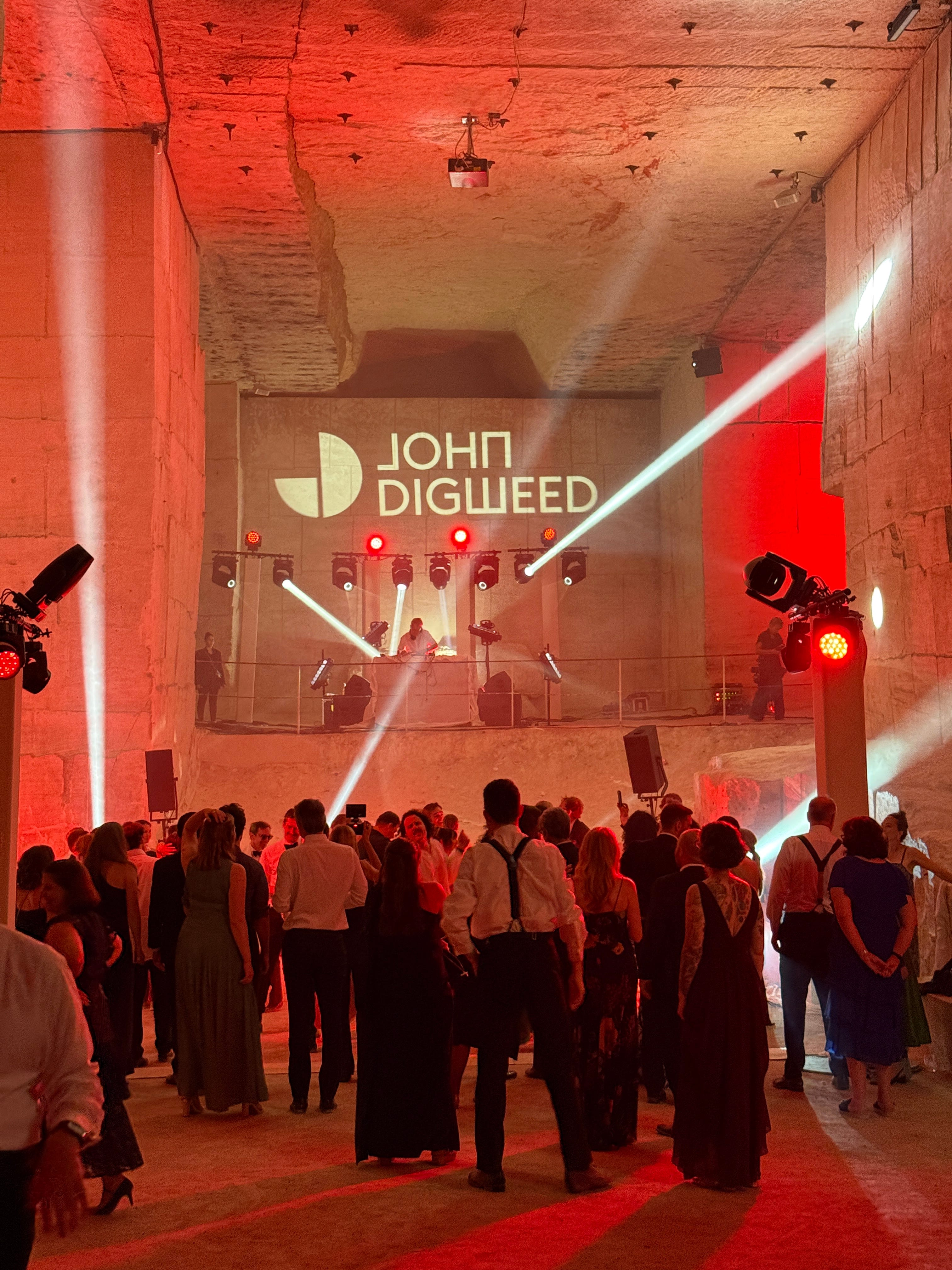
I’ve spent the last few days in the south of France celebrating the marriage of my two most eccentric friends. The night before the wedding, the couple revealed that the 175 or so of us would be bussed to a secret location for the reception. Carrières des Lumières, located near Les Baux-de-Provence, was originally a limestone quarry that supplied the same rock that built the medieval village of Glanum, the castle of Les Baux, and other nearby towns. The quarry closed in 1935 as the demand for stone gave way to steel and concrete and more malleable building materials, though not before becoming, by its very destruction, something of a beautiful space itself.
Jean Cocteau filmed The Testament of Orpheus there in 1959, but this cavernous maze more or less went unused until 2012, when it became the site of immersive digital art exhibitions of historically important artists like Picasso, Van Gogh, and Dali. We arrived at the quarry that evening and, as a nod to its former function, had to excavate our table numbers from a seating chart buried under a few inches of ground limestone. Waiting at our chairs, we each found a unique card from Brian Eno and Peter Schmidt’s Oblique Strategies decks. The above quote, which I had never encountered before – or more likely and appropriately had forgotten – was the one on my plate.
That’s something I notice about myself lately: How much I’ve forgotten. Logging into the backend of Substack for the first time in forever, I now see that the last time I wrote anything here, I wrote about this very topic. Six months ago – not even. Yep. No recollection.
As before, I don’t mean the slow erosion of aging. There are too many things from too long ago that I remember way too solidly. As before, I mean I’ve just forgotten how to pay attention. (Still struggling with that apparently!) I forget the names of characters from television shows I just watched. I forget the plots of movies I saw but a month ago. Books I’ve spent months hacking through eventually become the same uncut blur. A guest at the wedding asked me, a music producer, what music I’ve liked recently. A totally reasonable question, yet one I couldn’t even begin to answer. “Maybe ear?” I said. “I think?”
Writing is, of course, the technology we invented to help us remember. In my case, I’d say it’s more so the act of writing that really cuts the limestone. (At least I thought it was!) The trick to memorizing Latin vocabulary, I learned in high school, was to fold a sheet of looseleaf and write out the translations across the divide, Latin to English then English to Latin. Writing forces me to slow down and pay attention. I suspect it’s also why I can remember the most throwaway early 2000s mixtape skits and the fifth or six or seven tracks of early 2000s indie albums. Not because they were important to me, and not because they were not important (sorry, Brian), but simply because I chose to write about them. I chose to slow down and pay attention, and in doing so entangled myself forever in their cobwebs.
As for apparently important things, one album I’ve completely, easily forgotten is Bedrock. It was a double-disc mix compilation of progressive house and trance put together by the British DJ John Digweed and released stateside by Ultra Records around 2001. My college friend Win had lent it to me in 2002 when I told him I wanted to learn more about electronic dance music, a passion of his rivaled only by his equally contagious zeal for lockpicking, memorizing our class facebook, and low-level campus trespassing.
Digweed was the world’s biggest DJ at the time alongside his friend Sasha, spreading the gospel of trance and progressive house when electronic dance music was still a bit of a punchline, especially in the States. This music was global but underground, as it were. Short of clubbing, which was not something I thought someone like me was even really allowed to do, like wearing a durag in public or getting my eyebrows reshaped, Win’s trance mix compilations were the safest way to make the trip without disturbing the locals.
I had no context for this music beyond the boxes — the boxes stacked on boxes of always discounted multi-disc Ibiza compilations by the looter gates at the doors of Tower Records in Cambridge. Everything about these boxes seemed a tad pornographic — an excess that only seemed to suggest to this prude how frivolous the music probably was.
Yet I listened to Bedrock with open ears. More than open ears really. I was actively trying to find something to like and, barring that, trying to understand how someone as wonderful as my friend Win could like it. What did he hear that the rest of us didn’t? The sense experience, which I do remember, felt similar to the first time I listened to Bitches Brew a few years earlier in high school. Faced with this solid block of sound whose instruments I couldn’t differentiate, whose rules and provenance I couldn’t quite make out, I put my faith in attrition. If I stuck it out long enough, my mind’s eye would eventually relax and something magical would snap into focus. Drugs and volume could speed up the process — this much was explained to me beforehand. But some habits are set in stone. I knew from the start I’d be cracking open Bedrock with my own skull.
I listened to this album nearly every day for at least a month in 2002, the soundtrack to walking from the quad to classes, to work study at the med school campus to the river and back. Maybe it was 2003? Something must have clicked eventually. At some point I became an electronic dance music guy. It wasn’t long before I found Plastikman on Audiogalaxy, then Jan Jelinek and Vladislav Delay and Matthew Herbert, then worked my way from the continent back to the Detroit mothership to Chicago and back out again.
It’s not a stretch to say my career as an electronic music producer begins with my friend Win’s borrowed copy of Bedrock. And yet I couldn’t remember a thing about Bedrock this weekend — not the name of a single track or artist.
I should be clear why this made me feel so bad. This past weekend I was standing next to that same Win inside the quarry when I learned that our newly married friends had booked John Digweed to perform in the final hours of their wedding reception. Win had known for months but was still in a reverie. Will Digweed play “Judy (Hooked On Coke)”? Will he sneak in a bit of “True (The Faggot Is You)”? Will he throw the groom a bone and open with “Listen” by Raff & Freddy? “Judy was a friend in need…” he began in a stiff robotic accent, confused when it became clear I couldn’t join in, disappointed when I thought the opening DJ was Digweed, and saddened even more so when Mina and I said our goodbyes before the final reveal.
We woke up early this morning to the photo above: John Digweed taking his place behind the decks in an abandoned limestone quarry. Bride and groom in ecstasy. Bedrock manifest.
I’ve been in motion since seven this morning getting back to Los Angeles. On the second of two train rides through the French countryside, I listened to Bedrock for the first time in two decades. I wish I could share some a-ha moment here, how some progressive house madeleine whisked me back to my first encounters with electronic dance music. Instead this album appears to have been more a personal enzyme, providing me some form of catalytic energy then quietly disappearing from my life altogether.
Had it left any traces in my own work? I wondered. Is the vogue-y suspended progression of “Listen” the forebearer for my own in my remix of DJ Seinfeld’s “She Loves Me”? Is “Judy” how I ended up using chopped-up breathing sounds so much? Is this whole album why I like people with weird out of pocket voices talking their shit over a steady kick?
Who can tell. I don’t pretend the music I love is particularly important or worthy of reconsideration or even really that good. Candidly, I’m on my spurs the second I sense anything resembling an “argument” to that end anymore. Man… Sometimes a Goo Goo Doll is just a goo goo doll.
Bedrock, like so many of dance music compilations from that era, is gleefully all lowercase. Freed from narrative and signification, the music merely resonates. I suspect some part of me is attracted to the humble, ephemeral spirit of it all.
To collapse a limestone cave, I learned inside a limestone cave, requires an extreme and sustained amplitude in the 3-7hz range for a typical chamber. You’d need millions of times more acoustic energy than a John Digweed set could produce to move rock significantly, I was relieved to read. You could take me at my word and argue Bedrock barely left a trace. Yet surely it must have moved something.
There’s another possibility lurking inside that Eno/Schmidt oblique. It’s somewhere between David Foster Wallace’s “What Is Water?” essay and the Paul Valèry quote, “Seeing is forgetting the name of the thing one sees.” We take the broader superstructures of our reality for granted — economic systems, language, harmonic organization. These big invisible things shape our perception of what matters more than we realize. To see – to truly see – is both to remember those invisible things, but also to forget the ways they make us see.
My proposed strategy: We can, to some extent, choose our broader superstructures. We can choose to kill our idols. We can choose to place the Lydian mode at the center. We can choose to forgo the fantasy suite and spend the night in our individual rooms. We can make our dents even if we don’t know how the cracks will fissure. In the collective wreckage of our time, someone will find their love and possibilities.
Speaking only for myself I thought the opening guy was pretty good
When I was in my 20s, I took a contract job editing a stodgy business book. In the middle of that contract, I accepted a different, career-shaping role that required me to move from Toronto to London. Rather than terminating the editing gig, I stubbornly convinced myself that I could do everything, and spent the weeks leading up to the deadline cramming, researching, having slightly contentious calls with an impatient author, giving half-formed notes and just generally doing a substandard job. I got fired, and I deserved it.
A couple months ago, I was looking back at some old emails when I came across a few exchanges from that gig. I was stunned to realize that the book was one I subsequently read twice in the ensuing decade—a time when stodgy business stuff was suddenly more important to me. Somehow I hadn't connected the dots at all.
A realization like that can temporarily destabilize you. What are all the other things you've said or experienced that you've forgotten and can never recover? Have I lived a rich life or am I just an aging idiot?
Anyway, that wedding sounded crazy!